Friday, 11 October 2013

Chapter 27

Dun Laoghaire-Dublin-London

Sadly, we packed up our six suitcases and moved out of the wonderful apartment we had lived in for 5 weeks in Dun Laoghaire.  Our host Marie, was absolutely delightful, and we both said that we certainly had hold of a four-leafed clover to secure it. 
We moved into a hotel in Dublin, about a five minute walk for Philip to get to and from work. This was the up side as it was nearly an hour one way to work from the apartment.

Philip's work building in the background.  Train station half way, from hotel room.

We have been in Ireland for 9 weeks, and have been very lucky with the weather.  Only a couple of inclement days, and nothing to stop us touring.  The best summer in 20 years we were told!  Another four-leafed clover?
On our last weekend in Ireland, we decided to head to the "sunny south east", to a place called Wexford.  This two hour journey by train was picturesque, as the track hugged the coast for most of the trip. 

Taken from train
We had arranged a pick up to tour the area before checking into our accommodation, so it was nice to see Eugene's smiling face as we got off the train.  As we learnt, he was a career fisherman who now drove taxis and he was a local, so imparted much information and funny stories.  One such story he told about his life on the sea, was the time he fell overboard while working one shift during rough weather. As he was hauled aboard, he was asked by his sympathetic crew not "if he was OK", but "are ya wet"!  We thought that was hilarious and typical of the many Irish stories we have heard.
Our first stop was Carracloe Beach and Ballinesker Beach.  Probably unfamiliar to you just as names, but if you have seen the movie Saving Private Ryan, then you would have seen the cliffs and beaches in the opening scenes depicting Omaha Beach and the D-Day landings.
This stretch of coastline is quite untouched and pristine, with hardly a soul around and very similar to Normandy.

Next on the list was Tintern Abbey, located on a small river that flows into Bannow Bay.  We were told that when the Earl of Pembroke set sail to Ireland (c1200) from Wales, his vessel was threatened with shipwreck.  Whilst swimming for his life, he vowed to found an abbey wherever he could safely land, so now Tintern de Voto, "Tintern of the vow" is located here. Now we have been to both "Tinterns" - Monmouthshire, Wales and Co Wexford, Ireland!


About 500 metres from the Abbey in a verdant vale with beautiful wooded scenery is the Colclough Walled Garden.  The 2.5 acre garden was built over 200 years ago, but it was abandoned to nature in 1959.  Extremely overgrown, volunteers are now restoring the ornamental and kitchen sections using information found on historical maps.  Today, with its  brook, bridges, thriving vegetable patch and fruit trees it is a credit to these people.

The verdant vale
The walled garden
Further along this peninsular, on a point leading into Waterford Harbour, is the Hook Lighthouse.  This 800 year old striped structure is one of the oldest operating in the world. On the opposite side of the estuary is a town called Crook.  This is where, we were told, the saying.." By hook or by Crook" came from.


Titanic wannabee
From Hook to Crook
 We visited the National Famine Memorial near Westport, but here in New Ross, our next stop, they have built a replica famine ship.  The "Dunbrody" was a three masted barque built in Quebec in 1845 for the local Graves family.  It was fitted with bunk beds, and between 1845 and 1851 she carried passengers, trying to escape the potato famine, to North America for sums of £3-£8 depending on class.  6 sq.ft was allowed for 4 passengers.  Unimaginable in today's terms.  Or is it, with the traffic of people on the waters around the world.

The barque, with its captain
The captain, with its bark
The town of New Ross is most notable for its association with the Kennedy family.  JFK visited here in 1963 just before his fateful trip to Dallas.  He was visiting the simple rural farm cottage that his great grandfather Patrick Kenedy (note the spelling) lived in prior to him leaving Ireland as a famine emigrant.  The visitor centre was recently opened by Caroline Kennedy in June this year, and is filled with memorabilia and photos and stories.  The descendants still live in the cottage.

Cottage to the left, barn to the right
After 6 hours touring, we were dropped off at Rathaspeck Manor for the night.  Built in the late 1600's by the Codd family, it passed down through many generations, and was even in the hands of the Moody family in the early 1900's!  (Not my family)  They sold it to the ancestors of the current family who have ditched the cows and farm animals and made an 18-hole golf course on the surrounding land.  Rathaspeck roughly translates to Fort of the Bishop, as it was home to some nuns for a while.  We slept in what was Father Alberts room.......what was he doing there you ask?
The rooms were magnificent and the Full Irish breakfast delicious.  We have found out that a Full Irish is a Full English without the baked beans!
We were offered free golf after breakfast, so we thought, why not. 
I haven't played for 20 years, so the challenge was huge.  I went around in 71, which Pip said was "one under par".  However, we only played 9 holes...... don't think Rory McIlroy will have to worry.  And Pip has since told me its not a "zig-zag" game, or that you get extra points to put the ball in the sand or ponds. That was my mistake!

Rathaspeck Manor
Ready...aim...
Thwack... why didn't the ball move?
Before boarding the train to return to Dublin, we had a quick lunch in The Wexford Centenary Stores pub.  Music drew us inside, and we were delighted to see 7 guys playing mandolins, fiddles, banjos, tin whistles, accordions  and a couple of Bodhrans.  The folk singing to accompany it was melodic.  Our feet were tapping, but not in a Riverdance way! Good Craic.


Well, we have now packed up the six suitcases yet again, and are off to London.  I must add here that we have had a wonderful time in Ireland, and we both think one of the highlights has been the culinary experiences.  The wealth of locally sourced ingredients from the sea and land is represented in the many cuisines we have tried.  And, of course, Guinness, well thats a whole food group on its own!

Now back to family and friends, which will be nice. 

Till the next blog
Love Annie
X

Sunday, 29 September 2013

Chapter 26

Visitors and venturing.....

We were delighted that our dear friends Chis and Sal from Sydney, who are now ensconced in Wales, caught the ferry from Holyhead to join us in Dun Laoghaire to see where we live. We had a wonderful weekend.  Again centred around food, wine, fun and walking.  And the weather was fine.......bonus.  We ate in, ate out and went to the local Farmers Market, full of amazing produce.  I am sure we all secretly go on diets each time we leave each other. 

Walking the East Pier in Dun Laoghaire
We were looking forward to the free aviation spectacle above the Liffey River called FlightFest.  So we, along with about 100,000 other people, braved the cold blustery conditions to crane our necks to catch sight of more than 30 aircraft flying dramatically low over the city skyline.  Some of the aircraft that took part were a B17 Flying Fortress, Catalina Flying boat, Sabre Fighters, along with an Airbus 380, which flew about 800 ft above us. Three planes did not attempt to fly because of the conditions.  I pity the pilots who had to keep their wits about them checking who was flying above, below, and beside them and with a crowd underneath.  We left about half way through, returned home, and realised the aircraft were turning above our apartment to do their laps into the city!  Oh well!

Flying up the Liffey


Our next visitors, Valerie, Derek and Gill, arrived a couple of weeks later for four days.  Valerie and Derek generously opened their home to us when we were in the UK, so it was nice to repay some hospitality.  As it was their first visit to Ireland, we decided on the HoHo bus, which is always good value and a good way to get an overview of a city.
The Guiness Storehouse, located at St James' Gate in Dublin, was one stop we all jumped off at.  Arthur Guiness founded this brewery in 1759 and was clever enough to sign a 9,000 year lease for the site @ £45 per year!   He had 21 children, so there must be something in the black brew, and I don't mean tea!  The self-guided tour is laid out over 7 levels in what was the old fermentation plant, with the tour finishing on the top floor at the Gravity Bar, giving 360 degree views of Dublin.  A pint of the black liquid in your hand was a welcome conclusion.  And I must say, it tastes soooo much better here. It is brewed in 60 countries........... so it must be the water?

4m high bronze sculpture of a pint of Guinness
St Patrick's Cathedral, was another stop.  A wooden church stood on this site from the 5th century.  The current building, built in 1191 by the Normans, is the largest church in Ireland and one of two cathedrals in Dublin.  The most famous holder of the office of Dean was Jonathan Swift, satirist and author of Gulliver's Travels, who is buried there.


Picking up on local recommendation, we took the train 30 mins south around the coast to a village called Bray.  The weather was a mild 22 deg, so we walked along the seafront, then headed to Kilruddery House, the large country home of the Brabazon family (the Earls of Meath), since 1618.  It is still in use as an 800 acre farm run by the current 15th Earl and his family, who open the home for 3 months each year. The gardens are the oldest in Ireland, still surviving in their 17C state.  It has been used as film locations for My Left Foot and Angela's Ashes.
We enjoyed a lovely lunch in the tearooms which were situated in the old Octaganal Dairy. The freshly grown ingredients picked from the Walled Garden made it more delicious.


One event that we did not get to was the National Ploughing Championships, a field of dreams for some.  Now I don't know whether that was lack of interest, or that we would find it too amusing and launch into uncontrollable laughter.  It was a three-day event showcasing tractors and agricultural machinery, with a few sheep and cattle thrown in.  3 days is a lot of sods to be ploughed.  Oh, and a welly-throwing contest.  The temperatures soared to 23 deg for the occasion.

While the weather was still holding up, we took the train due west across Ireland to the town of Westport, in Co Mayo, about a three hour journey.  The town is nestled around the shores of Clew Bay which hosts 365 islands, and last year was named the "Best Place to Live in Ireland".  It was designed in 1780 in the Georgian style of architecture and features the river Carrowbeg with its quaint stone bridges. 


One of the draw cards to this area is Croagh Patrick, known locally as "the Reek", a mountain which offers a dramatic backdrop (at 764m ) and a place of pilgrimage.  St Patrick is supposedly to have spent 40 days and 40 nights in the 5th century, praying at the top, before driving out all the snakes from Ireland. We decided we had to give it a go, so we collected our walking sticks, and headed up.  We were told 2-3 hours up and 1.5 back should do it.  We walked about half way up, and then the knees gave out!  "He could have chosen a less difficult place for followers to visit", we overheard someone say.  One guy was carrying a bike, and there were others jogging? Extremely arduous as underfoot were pebbles, rocks, loose scree and mud, but we were rewarded with an amazing vista. Our 70 mins up included me falling up, and slipping down.


The taxi driver that we used to take us there left his business card to enable us to call him for the return trip.  Turns out he was also a funeral director.  We wondered whether he used the same vehicle for both businesses.  I guess it's all human trafficking.

Each side of the business card
Close by and at the base of the mountain was the National Famine Memorial.  A sculpture of a "Coffin Ship", as they were called, sits in a beautiful green field, with the bay as its backdrop.  These ships left the Irish shores with those wishing to escape the poverty and famine of the 1840's, but  many did not make it to the New Continent.  One million died in the famine and one million emigrated. 


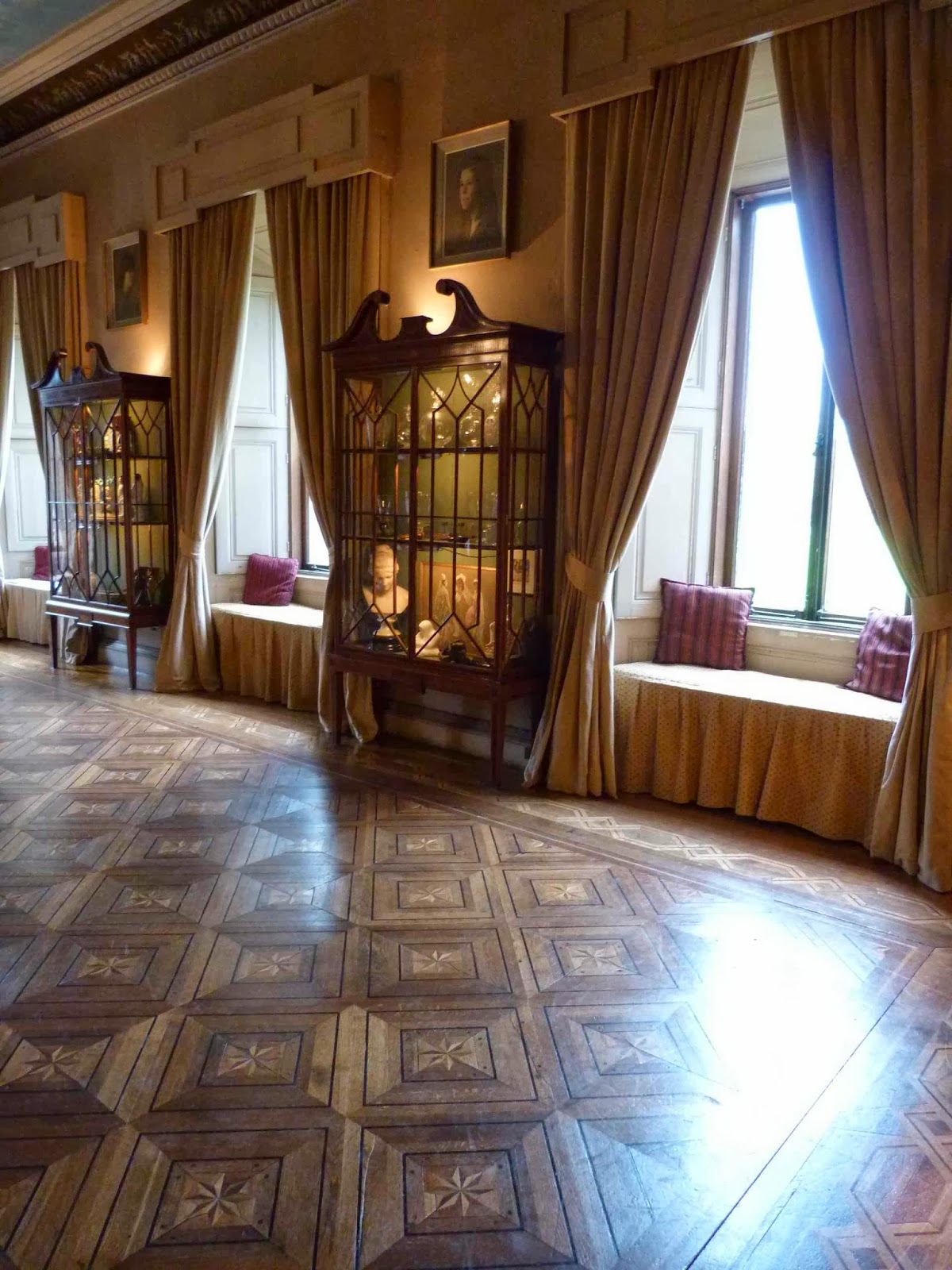
The famous pirate Queen, Grace O'Malley, built one of her many castles in Westport in the 1500's.  The Browne family, her direct descendants are custodians of today's home, built in 1730, now on the site.  The remains of the original castle are still evident in the basement.....believed to be dungeons.  Full of artwork and treasures, we walked through the 30 rooms on show. 

Westport House
Long Room

Entrance Hall
Drawing Room - great floor

Till the next blog.

Love Annie
xx

Sunday, 1 September 2013

Chapter 25

Dun Laoghaire to Belfast return......

We are now settled into our apartment and are loving it.  We have a non-stop flow of ferries, catamarans and yachts to watch from our living room and balcony.  The local village shops are varied and plentiful and there is a big Farmers Market each Sunday in the local park which offers a wide range of local produce. 
I have resumed my morning walks which now involve a 40 minute walk along the west pier. Sea air, a breeze and vistas far reaching.  I love the sea.
As I have said previously, we want to discover what is north of Dublin, so headed to Belfast for a weekend on the train. 
Belfast, or Beal Feirste, is Gaelic for "mouth of the river", and is the capital and largest city in Northern Ireland with a population of about 250,000, on the river Lagan. Once riddled with destruction and conflict, a period in history called "The Troubles", it has changed enormously.  It is still a politically sensitive city, and the scars  remain, with a wall that divides the Catholics and the Protestants called the Peace wall still in existence.  We signed the Peace wall, as have thousands of others.  We both found our stop here extremely moving and hard to comprehend.


We stayed at a marvelous boutique hotel called Ten Square which was very central.  Upon arrival we were handed a glass of champagne, as we completed check in.  We thought how wonderful is this......!
So we decided on dinner at the hotel.  After carefully studying the menu, we chose a fish dish and steak dish.  The chicken dish would have to wait for another time........

An intriguing description, but we decided against...
To help utilise our time for the weekend we chose a personal tour of the must-see sights. This was an 8 hour trip.  We were picked up at 9.00am by Mick, or Michael, (we were allowed to choose what we called him), very Irish and very funny.
First stop was Dark Hedges.  Architectural, atmospheric and peaceful are words I would use to describe these 150 beech trees planted over 200 years ago on a road in Co Antrim. Creating a natural arch with entwined branches,  the trees are now protected and a tourist attraction.


Next stop was Ballintoy, a small village with a quaint harbour.  Both have been showcased in the TV series Game of Thrones, with the village renamed Lordsport and the harbour redressed as the Port of Pike.


We were lucky with the weather, with only a few short showers to dampen the day, which was fortunate as our next stop on the coast involved adrenalin and concentration.  After a 15 minute walk to the cliffs edge, we saw a rope bridge.  30m above the rocks and with a 20m span, we crossed to the island of Carrick-a-rede from the mainland.  We were rewarded with fantastic views and a glimpse of Scotland 17 miles in the distance.  Wind gusts added to the adventure as we tried to stop ourselves from falling over. 

View of rope bridge
PC returning


View to the south east from rope bridge

View to the west from rope bridge

Keeping in the theme of adventure, 12 miles further on and lying on the NE coast is the Giants Causeway.  A Unesco World Heritage site of geological wonder with over 40,000 interlocking basalt columns, a result of volcanic activity many millions of years ago.  The regularity of the stone shapes and the vastness of number has made this a well known tourist attraction.  It is also steeped in legend and myth with a giant called Finn MacCool apparently building this causeway to get to Scotland.


Our driver asked if we liked a tipple, to which we replied a resounding YES!  So, after lunch where Michael ordered the "Pheasant Beater's Nosebag", he did a detour to The Old Bushmills Distillery.  Now whiskey is not a drink we favour, but we have to say Irish whiskey was decidedly different to Scotch whisky - and spelt differently as well.  We quite liked it.

1 barrel down - 29 to go (hic)...
We climbed back in the car, with our next stop Dunluce Castle. The earliest standing remains date back to the 13th century when it was built by the 2nd Earl of Ulster.  It has a fascinating history with involvement from the English and the Scots at various times.  It gradually fell into ruins, but you do get an idea of the isolation, wealth and power of the last 800 years.

Inner courtyard at Dunluce Castle
A lone musician playing a hammered dulcimer

View of Dunluce Castle
It was getting late in the day, so we headed back to base.  The last part of our day trip was the Belfast sector.  Behind every city is a story, with Belfast one of fascination and heartbreak.  Our driver gave us an insightful look at "his" home.  Bought up a Protestant who married a catholic and was subsequently shunned by his "Mam", he drove us through both areas.  West Belfast is Catholic and East Belfast Protestant.  Political murals, particularly in the poorer areas,  are situated on gable walls of buildings each depicting a story of conflict. There were also hoardings with names and faces of people "murdered" but not forgotten.


Confronting...
A new addition to Belfast is the Titanic Experience.  Completed 12 months ago, to celebrate the 100th anniversary of her departure from port.  The building is in the shape of a star to represent White Star Lines, the highly prominent shipping line that owned Titanic.  An excellent display telling the story from conception in the early 1900's through construction and launch to her catastrophic demise.  We also walked in the dry dock, where she sat on keel blocks to be fitted with propellers and be painted.  At nearly 900 feet long and just over 46,000 tonnes, she would have appeared whale like when viewed from beneath.

View from half way along the dry dock

Titanic Museum building
When we checked the opening times for the museum, their web site stated "Monday-Saturday 09:00 - 17:00, and Sunday 09:00 - 17:00".  Had to read that twice before seeing the Irishness of it.  That went well with sign we saw at the Dublin train terminus station which tells you to remain behind the yellow line since high-speed trains pass the platform!  Philip chuckled for quite a while over that one.

Having had a wonderful weekend, we vowed to return to explore more of Belfast and beyond.  I am sure there are many more stories.

Just to finish off this blog, I want to share this quote.....

"A wise nation looks back with one eye, a blind nation looks back with two eyes."

Till the next blog
Love Annie
Xxx